


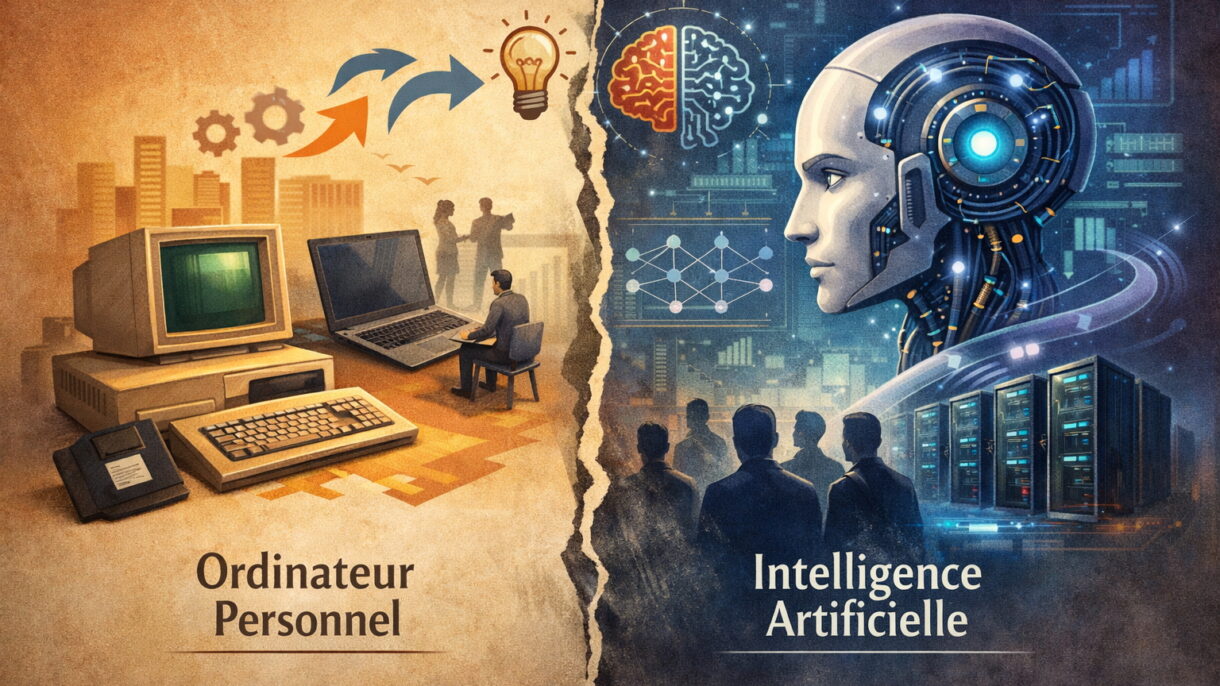

As artificial intelligence (AI) systems rapidly improve and spread across industries, a common argument emerges: the AI shift is comparable to the rise of the personal computer (PC) in the 1980s and 1990s. According to this view, AI represents another technological wave—initially disruptive, eventually normalized—requiring adaptation rather than concern.
While this comparison is not without merit, it has clear limitations. A closer examination reveals that, although the two transformations share similarities, the nature and implications of the AI shift may be fundamentally different.
1. Shared characteristics between the PC and AI revolutions
There are legitimate reasons why the comparison persists.
- General-purpose technologies: Both the PC and AI are applicable across a wide range of sectors.
- Productivity gains: Each promises efficiency improvements through automation and digitalization.
- Initial anxiety: Both sparked fears about job losses and skill obsolescence.
- Learning curve: Adoption in both cases requires new competencies and changes in workflows.
From this perspective, viewing AI as part of a recurring historical pattern is understandable.
2. Passive tools versus active systems
A key difference lies in the nature of the technology itself.
- The personal computer is fundamentally a passive tool. It executes explicit instructions provided by a human user.
- Modern AI systems function as active systems. They generate content, infer patterns, and can operate semi-autonomously.
This distinction reshapes the human role. While PCs extend human capabilities, AI systems can, in some cases, perform tasks independently from end to end.
3. The type of work affected
Earlier waves of automation primarily targeted:
- physical labor,
- repetitive administrative tasks.
AI increasingly impacts work traditionally associated with human cognition:
- writing,
- analysis,
- software development,
- translation,
- design.
The PC required human judgment to interpret and apply information. AI systems increasingly operate within that interpretive layer, raising different questions about task allocation.
4. Speed of change and adoption
The tempo of transformation also differs significantly.
- Personal computers spread gradually over several decades.
- AI systems evolve through rapid iteration cycles, with noticeable capability jumps in months rather than years.
This acceleration compresses the time available for workers, institutions, and education systems to adapt incrementally.
5. Access, infrastructure, and concentration
The PC contributed to a broad democratization of computing:
- relatively affordable hardware,
- open development ecosystems,
- decentralized innovation.
Contemporary AI relies more heavily on:
- large-scale infrastructure,
- massive datasets,
- substantial capital investment.
As a result, questions about centralization of technological and economic power play a more prominent role than they did during the PC era.
6. Rethinking the idea of “adaptation”
The claim that one can simply “adapt” assumes that skills, once acquired, remain valuable long enough to justify the investment.
In the context of AI:
- certain skills may become obsolete quickly,
- continuous learning becomes less stable and more fragmented.
Adaptation remains possible, but it may no longer offer the same long-term security it once did.
7. A helpful analogy—with limits
Comparing AI to the personal computer can help reduce panic and situate innovation within historical precedent. However, the analogy becomes insufficient when examining deeper structural effects.
The PC reshaped how people worked.
AI increasingly challenges which tasks require human involvement at all.
Conclusion
The comparison between artificial intelligence and the personal computer is neither entirely wrong nor fully adequate. It highlights shared dynamics of technological adoption while obscuring meaningful differences in system behavior, speed of change, and economic structure.
Rather than viewing AI as a simple repetition of past technological shifts, it may be more accurate to see it as a transformation whose long-term implications—for work, skills, and value creation—are still unfolding.
